


Kensington House Antiques
$2,450.00
$2,450.00
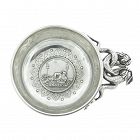
A tour-de-force first standard (950/1000 pure silver) tastevin by silversmith Stanislas Pollet celebrating Napoleon’s great victory at the Battle of Wagram. The tastevin is inset with a Napoleonic silver medal surrounded by fleur-de-lis engraving. The outer edges are enhanced with ornate strapwork (a technique particularly mastered by Pollet) depicting fleur-de-lis and acanthus leaves. The entire design is set off with a pair of magnificently cast and engraved dolphins forming the handle.
Napoleon, never particularly known as a shrinking violet, enjoyed commissioning medals from the Paris Mint to celebrate his victories and various life landmarks. The front of the medal (showing from the top of the tastevin) depicts the river god of the Danube being forced by the Emperor to carry a wooden pontoon bridge laden with French cannons over the river towards the Imperial Austrian capital, Vienna. The Latin inscription translates as, “Danubius, indignant at the breach/Battle of Essling/May 22, 1809.” The reverse (showing from the bottom of the tastevin) depicts the French army marching across the bridge at Wagram, urged on by the goddess of Victory carrying a laurel wreath and pointing the way. The inscription translates as, “Again crossing at the same place/July 5, 1809.” The Battle of Essling was the first defeat of the French army under Napoleon’s direct control, but that fact is obscured by combining it with the Battle of Wagram, just forty-four days later. This latter battle was one of the emperor’s greatest victories and was the largest battle in European history up to that time. The medal was created at the Paris Mint by the medalist Nicolas-Guy-Antoine-Brenet under the supervision of Baron Dominique Vivant Denon, who was Napoleon’s artistic director and to whom the emperor entrusted the Louvre after turning it into a museum. A single copy of the medal was struck in gold for Napoleon’s personal collection. Silver medals were given as gifts to the emperor’s friends and diplomats and bronze versions were available to those of lower rank.
Napoleon, never particularly known as a shrinking violet, enjoyed commissioning medals from the Paris Mint to celebrate his victories and various life landmarks. The front of the medal (showing from the top of the tastevin) depicts the river god of the Danube being forced by the Emperor to carry a wooden pontoon bridge laden with French cannons over the river towards the Imperial Austrian capital, Vienna. The Latin inscription translates as, “Danubius, indignant at the breach/Battle of Essling/May 22, 1809.” The reverse (showing from the bottom of the tastevin) depicts the French army marching across the bridge at Wagram, urged on by the goddess of Victory carrying a laurel wreath and pointing the way. The inscription translates as, “Again crossing at the same place/July 5, 1809.” The Battle of Essling was the first defeat of the French army under Napoleon’s direct control, but that fact is obscured by combining it with the Battle of Wagram, just forty-four days later. This latter battle was one of the emperor’s greatest victories and was the largest battle in European history up to that time. The medal was created at the Paris Mint by the medalist Nicolas-Guy-Antoine-Brenet under the supervision of Baron Dominique Vivant Denon, who was Napoleon’s artistic director and to whom the emperor entrusted the Louvre after turning it into a museum. A single copy of the medal was struck in gold for Napoleon’s personal collection. Silver medals were given as gifts to the emperor’s friends and diplomats and bronze versions were available to those of lower rank.
- Origin: France, 1899-1903
- Condition: excellent, sharp detail
- Dimensions: 3-1/2” x 4-5/8” x 1-1/4”
- Weight: 201.4 grams
Kensington House Antiques
$750.00
$750.00
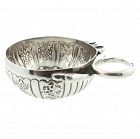
A Burgundian first standard (950/1000 pure silver) tastevin by acclaimed silversmith Marc Parrod. The style of this particular example is a bit of a departure from Parrod’s typical style. The handle is worked in the form of a snake, thought to represent the the snake from the Garden of Evil as a reminder that wine may lead to earthly temptation. But the bowl Parrod experimented with the decoration to the bowl. The elongated “godrons”, intended to help assess the color and clarity of wine, are pushed all the way up the sides of the bowl in a style more typical of the 18th century. A series of “perles” are arranged in a circle at the base of the “godrons.” Between the “godrons” Parrod has added repoussé decoration of grape clusters. And most interestingly, rather than a smooth surface, Parrod created a hammered texture that further enhances the wine’s color. The rim is engraved “Vernier Morey 1740.” The meaning of the engraving is unclear, but both names are familial names long associated with very good Burdundy wines. Obviously, the date was intended to represent the founding of a vineyard, a dynastic marriage, or some other major local history event. The rim is slightly out-of-round, but this is in the making where the engraving and maker’s marks were applied—a quirk that is not uncommon in French silver. The handle and body are stamped with the French first standard mark and Parrod’s master’s mark.
- Origin: France, ca. 1910
- Condition: very good, a small flattened area on the bottom edge under the handle visible when turned upside down
- Dimensions: 3” x 4” x 1-1/4”
- Weight: 88.6 grams
Kensington House Antiques
$750.00
$750.00
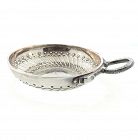
A rare French silver (950/1000 pure silver) tastevin from the reign of Louis XVI. This classic example features a classic design of angled “godrons” (grooves) accented with raised “perles” (pearls). The lack of deeply recessed “cupules” suggests that this wine taster was specifically intended for use with white wines. The center of the bottom has the expected tiny lathe mark where the vessel was raised from a solid block of silver. The handle is formed as a coiled snake in the traditional manner. The edge is engraved with the name of the original owner, Monsieur Robert. The tastevin bears the charge and discharge marks for Paris (1789) and an illegible master’s mark.
- Origin: France, 1789
- Condition: excellent
- Dimensions: 3-1/16” x 3-7/8”
- Weight: 72.9 grams
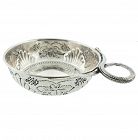
An elegant second standard (800/1000 pour silver) French tastevin. Rather than the typical "perles" and fluted "godrons," the bowl is decorated with repousse grape leaves, berries and shells in the 18th century style. This treatment is sometimes seen in tastevins made by Parrod, one of the most influential makers of tastevins in the 19th and 20th centuries. The single snake handle, thought to represent the snake from the Garden of Eden reminding drinkers of temptation, has an unusually well-detailed head. The tastevin is fully hallmarked and has an illegible maker's mark, possibly Parrod's.
- Origin: France, ca. 1925
- Condition: excellent, sharp detail
- Dimensions: 3-1/4" x 4-1/4" x 15/15"
- Weight: 55.9 grams
Kensington House Antiques
$265.00
$265.00
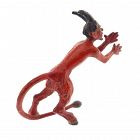
Cold-painted Viennese bronze sculpture of a devil by Franz Bergman. This half-goat half-man figure is very well detailed, even showing the individual vertebrae along his back and the curls of his hair.
- Origin: Austria, ca 1900
- Condition: near mint; tiny surface rubs at sharp points such as the fingertips
- Dimensions: 2-1/4" tall
Kensington House Antiques
SOLD, PLEASE VISIT US AGAIN!
SOLD, PLEASE VISIT US AGAIN!
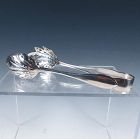
Handsome pair of sterling silver ice tongs in the "John Winthrop" pattern by International Silver Co. This is one of the classic American Colonial patterns developed during the early 20th century when people were first beginning to be interested in American antiques. Curiously, the simple design was also a perfect match for the upcoming Art Deco styles of the 20s and 30s. Ice tongs were an uncommon serving piece and are very difficult to find today. The tongs are marked with International's older hallmark.
Origin: America, ca 1911. Condition: excellent, no dings, period "S" monogram. Size: 6-3/4" long. Weight: 63.0 grams.
Kensington House Antiques
$595.00
$595.00
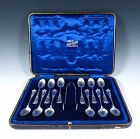
An set of twelve English sterling silver coffee spoons and a matching sugar tong in an elegant rococo pattern by silversmith Joseph Rodgers. The handles are lightly monogramed with an “H.” The bowls are a bit larger than typical demitasse spoons, so they could easily be used for tea service, as well. The set is presented in its original fitted case lined with royal blue velvet and silk. The interior of the lid is embossed with the retailer’s stamp for William Batty & Sons, one of England’s finest watchmakers and jewelers outside of London at the time.
- Origin: Sheffield, England, 1910
- Condition: excellent; interior of case is excellent; case exterior is mostly good, but with bookbinding tape at the hinge side
- Dimensions: spoons, 4-5/16” long; tong 4-1/2” long
- Weight: 206.4 grams.
Kensington House Antiques
SOLD, PLEASE VISIT US AGAIN!
SOLD, PLEASE VISIT US AGAIN!
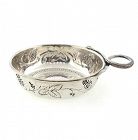
An elegant second standard (800/1000 pure silver) French tastevin. Rather than the typical “perles” and fluted “godrons”, the bowl is decorated with repousse grape leaves and berries in the 18th century style. This treatment is sometimes seen in tastevins made by Parrod, one of the most influential makers of tastevins in the 19th and 20th centuries. The single snake handle, thought to represent the snake from the Garden of Eden, thus reminding drinkers of temptation, has an unusually well-detailed head. The tastevin is fully hallmarked and has an illegible maker’s mark, possibly Parrod’s.
- Origin: France, ca. 1925
- Condition: excellent, sharp detail
- Dimensions: 3-5/16” x 4-1/4” x 15/16”
- Weight: 58.8 grams
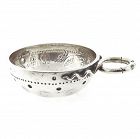
An elegant second standard (800/1000 pure silver) French tastevin. The bowl is engraved with repousse grape clusters and leaves in the 18th century style, but also with the more traditional raised “perles” and “coupules” seen in 19th century examples. The combination of the two is quite unusual. The handle is in the form of two snakes grasping an apple between their jaws—an element thought to stem from the Garden of Eden and intended to remind drinkers of temptation. The tastevin bears regional hallmarks for second standard silver and an unknown maker’s mark (J ancre de marine P). The pinpoint in the bottom of the bowl is a lathe-mark and suggests a date of the mid-19th century at the latest. The rim is engraved with the name of the original owner, “Ane [Antoine] Mouly-Chambon de Chas.”
- Origin: France, Burgundy region, ca 1840
- Condition: excellent
- Dimensions: 3-1/8” x 4-1/4” x 1-5/32”
- Weight: 118.4 grams
Kensington House Antiques
$495.00
$495.00
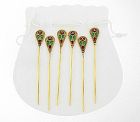
A lovely set of six sterling silver and plique-a-jour enamel cocktail picks by acclaimed Norwegian silversmith and enamelist Johan G. Kjaerland. Kjaerland worked in Bergen, Norway, and was particuarly well-known for his excellent plique-a-jour enamels. This is the first set of cocktail picks we've seen in plique-a-jour. Each is hallmarked appropriately.
- Origin: Norway, ca. 1900
- Condition: excellent, no enamel damage, gilding intact
- Dimensions: 3-11/16" long
- Weight: 16.7 grams
Kensington House Antiques
SOLD, PLEASE VISIT US AGAIN!
SOLD, PLEASE VISIT US AGAIN!
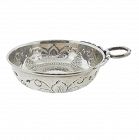
An elegant second standard (800/1000 pure silver) French tastevin. Rather than the typical “perles,” "coupules," and fluted “godrons”, the bowl is decorated with repousse grape leaves and berries in the 18th century style. This treatment is sometimes seen in tastevins made by Marc Parrod, one of the most influential makers of tastevins in the early 20th century. The handle is in the traditional form of two entwined duck-headed snakes grasping an apple in their mouths, thought to represent the snake and apple from the Garden of Evil, thus reminding drinkers of temptation and sin. The tastevin is fully hallmarked and has an illegible maker’s mark, possibly Parrod's.
- Origin: France, ca. 1910
- Condition: excellent, sharp detail
- Dimensions: 3-5/16” x 4-1/4” x 15/16”
- Weight: 55.3 grams
Kensington House Antiques
SOLD, PLEASE VISIT US AGAIN!
SOLD, PLEASE VISIT US AGAIN!
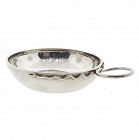
French Silver Louis XVIII Burgundian Style Wine Taster Tastevin
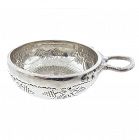
An unusually heavy first standard (950/1000 pure silver) French tastevin decorated in the classic Burgundian style with punchwork grape clusters and a coiled snake handle. The grapevines are also accented with engraved flowers. The bottom has the center pinpoint found in tastevins from this period and is finished simply with a ring or shallow godrons around the edge to help reflect light through the wine. The snake is engraved with scales and has an unusual arrow-shaped tail. The rim is engraved “A. Chantal” for the original owner. The tastevin has the “tête medecin” mark for silver and the silversmith’s mark for Charles-Marie Guidée (Paris).
- Origin: France, 1819-1838
- Condition: very good, a few small flat areas from 200 years of use
- Dimensions: 3-5/8” x 4-3/4” x 1-5/16”
- Weight: 121.2 grams.
Kensington House Antiques
$495.00
$495.00
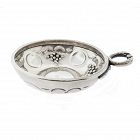
A classic second standard (800/1000 pure) silver tastevin from the Loire Valley of France. The origins of tastevins can often be identified by the tastevin’s shape. In this case, the bowl is rather shallow and completely without decoration. The handle is formed in the shape of a thin, curvy snake, but is worked without extra decoration such as scales or details to the head. This example is rather early, as is evidenced by signs of hand hammering and the small lathe mark in the middle of the bowl. The bottom is stamped with the original owner’s name, P. Roux. These classic tastevins from the Loire Valley are charming for their simplicity. Stamped with French silver marks and an unidentified maker's mark.
- Origin: Loire Valley, France, ca. 1840
- Condition: excellent
- Dimensions: 2-7/8” diameter (excluding handle)
- Weight: 29.9 grams
Kensington House Antiques
SOLD, PLEASE VISIT US AGAIN!
SOLD, PLEASE VISIT US AGAIN!
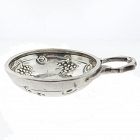
A very good first standard (950/1000 pure) silver small-size tastevin by the highly regarded Dijon silversmith Marc Parrod. This example retains the classic round shape with a convex bottom, but the usual "godrons" and "cupules" are replaced by repoussé grape clusters alternating with "cupules". Each grape cluster is accented with stylized vines. Parrod was particularly noted for this unique variation. The handle is in the traditional form of two snakes grasping an apple, alluding to the the Garden of Eden snake and reminding the drinker of temptation. These smaller tastevins are less common than the larger ones. Smaller tastevins from the Bordeaux region were often used for tasting Cognac, so perhaps the smaller Burgundian versions were used for some other spirit, as well as wine. The bottom and handle are stamped with first-standard silver marks and with Parrod's mark.
- Origin: Dijon, France, ca. 1903-1944
- Condition: excellent, no dings or monograms, sharp detail
- Dimensions: 2-1/4” diameter (excluding handle)
- Weight: 24.6 grams
Kensington House Antiques
SOLD, PLEASE VISIT US AGAIN!
SOLD, PLEASE VISIT US AGAIN!
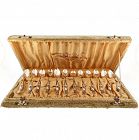
A very good first standard (950/1000 pure) silver small-size tastevin by the highly regarded Dijon silversmith Marc Parrod. This example retains the classic round shape with a convex bottom, but the usual "godrons" and "cupules" gare replaced by repoussé grape clusters alternating with raised "perles". Each grape cluster is accented with stylized vines. Parrod was particularly noted for this unique variation. The handle is in a rather unusual shape slightly suggestive of the double snake handles sometimes found on tastevins from the Bourgogne region. These smaller tastevins are less common than the larger ones. Smaller tastevins from the Bordeaux region were often used for tasting Cognac, so perhaps the smaller Burgundian versions were used for some other spirit, as well as wine. The bottom and handle are stamped with first-standard silver marks and with Parrod's mark.
- Origin: Dijon, France, ca. 1903-1944
- Condition: excellent, no dings or monograms, sharp detail
- Dimensions: 2-1/4” diameter (excluding handle)
- Weight: 25.8 grams
Kensington House Antiques
$395.00
$395.00
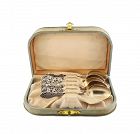
A lovely set of twelve sterling silver demitasse spoons presented in their original fitted velvet and silk box. The design features a scroll of acanthus leaves along the stem with an asymmetrical shell at the handle. The backs are stamped “Sterling” (prior to 1915), American silver was not required to bear a maker’s mark. The pattern is nearly identical to Knowles’ “King” pattern. The spoons are presented in their original velvet and silk fitted box from Hamilton & Diesinger of Philadelphia (1895-1900).
- Origin: America, ca. 1895
- Condition: spoons are excellent except one which has a tiny ding right at the tip of the bowl; sharp detail; no monogram; box is functional, but has significant wear. One of the 2 latches is broken at the top of the latch.
- Dimensions: spoons, 3-7/16” long
- Weight: 77.2 grams
Kensington House Antiques
SOLD, PLEASE VISIT US AGAIN!
SOLD, PLEASE VISIT US AGAIN!
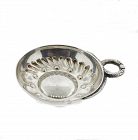
A very nice small-size silver plate wine taster in the classical style. The bottom features the typical convex bottom surrounded by concave "godrons" adn "cupules." intended to create high and low spots to better appreciate the color of the wine as light is reflected through it. The open shape also allows the bouquet to develop quickly so the wine can be tested easily. The snake handle is generally seen on tastevins from the region of Bourgogne. The tastevin bears an unidentified maker’s mark.
- Origin: France, ca. 1890.
- Dimensions: 2 1/4" diameter excluding handle.
- Condition: excellent, no dings, sharp detail.
Kensington House Antiques
$295.00
$295.00
A boxed set of sterling silver demitasse spoons by Paye & Baker. The set comprises two each of three different floral themes, all worked in the same intaglio style with glossy flowers and foliage against a stippled background. Two of the spoons are decorated with a pattern of wild roses, two with morning glories and two with pansies. The edges of the stems and handles are shaped to match the patterns. The bowls are finished with matte gilding. The backs are hallmarked by Paye & Baker and are marked "Sterling". The company made only a small range of products, but their Art Nouveau motifs were expertly designed.
- Origin: America, ca. 1900.
- Dimensions: 4" long.
- Weight: 38.8 grams.
- Condition: spoons, excellent condition, typical light fading of gilding on bowls; box has typical discoloration and wear.